

Nordic Contemporary Art Center launches Nordic Group Exhibition
2024-04-23
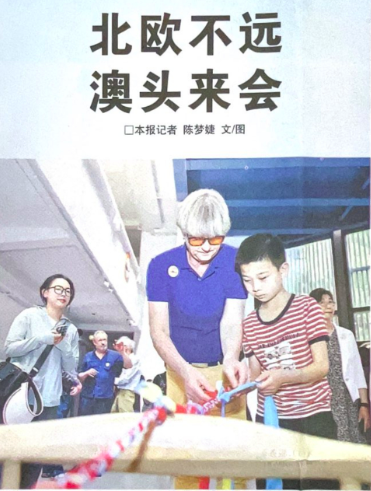
Recently, 11 Nordic artists from Denmark, Norway, and Sweden took up residency at the NAC to create new works, which were subsequently put on display.
At the entrance to the exhibition hall stands a newly completed piece titled The Dialogue Bench, which has drawn many visitors to sit down and engage in conversation with the artists. This work is a creation of the Swedish artist Pontus and his wife, the Dane artist Tina. The bench features an S-shaped design, providing a space conducive to meeting and extended conversation; its layout allows two individuals to sit together while still maintaining their own sense of personal space. Along the backrest, Tina has crafted vibrant floral motifs—fired into ceramic tiles—to serve as decorative accents. On the opposite side, images of whimsical, fairytale-like creatures created by Pontus are also inlaid into the structure: they possess the heads, hands, and feet of animals, yet feature human bodies and expressions filled with love. Pontus has dedicated his life to creating works centered around this figure, transforming it into a public sculptural icon that is now a household name throughout the Nordic region. As Pontus explains, this figure conveys the most important emotion in the world: love.
Interestingly, the antique porcelain shards and seashells Tina gathered along the coast at Aotou—as well as the Gongfu Tea cups she purchased—are scattered across the Dialogue Bench like stars. She told reporters that in Northern Europe, people typically simply toss a small pinch of tea leaves into a large mug and sip from it all day long. However, after arriving in Xiamen, she discovered that everyone invariably invites you to share a cup of Gongfu Tea. People share a single pot of tea using their own small cups, conversing about the past, the future, and everything under the sun—it is absolutely fascinating. Ever since they began drinking Gongfu Tea, Tina and her family have fallen in love with this particular way of tea drinking. "After a busy day, I like to brew myself a nice cup of Gongfu Tea as a well-deserved treat. When important guests visit, we also serve them Gongfu Tea." Tina noted that ceramics originated in China; upon reaching Denmark, they became integrated into the local culture, and through the creative work of artists, have now returned to China in a brand-new form. Adorning this Dialogue Bench are porcelain shards fired in Denmark, alongside antique Chinese porcelain and Gongfu Tea cups; this, too, constitutes a form of dialogue—one that symbolizes different nations and civilizations engaging in exchange through mutual respect and on equal terms.
Dane artist Tina Jacobsen has long dedicated herself to interpreting urban and natural environments in a poetic manner. Her latest exhibition, A Sudden Purple Sentiment, features a series of paintings created on paper and linen, taking the undulating mountain ranges of Fujian as their subject. "You know, we have almost no mountains in Denmark; our highest peak is called Himmelbjerget—the Sky Mountain—yet it stands at an elevation of only 170 meters. Consequently, for me, mountains represent dreams and distant horizons. The mountains of Fujian rise and fall like the ups and downs of life itself, imbued with a profound richness of meaning." Tina holds a deep affection for Chinese painting, describing herself as a child just beginning to learn the art form. Although she employs oil painting brushes, A Sudden Purple Sentiment bears the distinct imprint of traditional ink wash painting. Furthermore, she has ingeniously outlined the contours of the mountain peaks directly onto the gallery walls, thereby linking the individual paintings to transform the entire space into a cohesive, immersive environment. The paintings themselves are hung in an overlapping, interlocking arrangement—resembling a collage—which further evokes the sensation of a vast, layered mountainscape. As for her choice of purple, Tina Jacobsen explains: "Purple is a color I previously avoided in my work, as it is a blend of red and blue—two colors that typically stand in opposition to one another. However, in today's world—faced with so many intractable problems—dialogue and communication have become more vital than ever; much like the blending of red and blue, such exchanges can yield truly unexpected and transformative results."
“In fact, there is a profound need for precisely this kind of dialogue between the East and the West. Many of the prejudices and misunderstandings that exist in the world stem from a scarcity of information; people simply need to make a greater effort to understand one another.” Tong Wang — a Chinese-Swedish artist participating in the current exhibition — has served as a visiting professor at both the Royal Danish Academy of Fine Arts and the School of Art at Xiamen University. In 2017, together with his wife, Lan Lan, he played a pivotal role in establishing the Nordic Contemporary Art Center, Xiamen. He told reporters that during their ten-day residency in Aotou, the Nordic artists engaged in far more than just artistic creation; they practiced Tai Chi, sang Nanyin(Southern Music), studied calligraphy, and painted traditional Chinese landscapes — immersing themselves wholeheartedly in Chinese culture and drawing deep inspiration from it. As Wang Tong chatted casually with the group, the sight of a butterfly would prompt him to recount the tale of Zhuang Zhou Dreaming of a Butterfly; passing by a fishpond, he would share the story of that famous philosophical dialogue—dating back over two millennia—between Zhuangzi and Huizi: “You are not a fish; how do you know what makes a fish happy?” In this manner — both relaxed and delightful — Chinese culture entered the cultural context of these Nordic artists, becoming a vibrant source of inspiration for their creative endeavors.
闽ICP备05022777号 ©2018 Visiting Reservation—Nordic Contemporary Art Center in Xiamen All Rights Reserved.
Add: 1# Huaiyuan Road, Xiang’an District, Xiamen, China
Mob: (+86)18750921083 (Miss Ke)
E-mail:lanlanart@vip.163.com